Welcome to the summer edition of our newsletter. There’s real momentum building across Taranaki’s catchments. From practical on-farm tools to hands-on workshops, farmers and communities are stepping up to strengthen freshwater, biodiversity and farm resilience.
We’re excited to be offering free fish passage assessments in partnership with Wai Connection. Understanding what’s happening in your farm streams is a practical step toward healthier waterways, and our trained team can help you identify simple changes that make a real difference.
We’ve also launched the new Good Farm Mapping Experience tool, a free planning tool that turns complex LiDAR data into clear, visual insights you can actually use. It’s designed to support better decisions, stronger planning conversations and targeted mitigation, without adding another layer of compliance.
Alongside these tools, we’ve got a strong programme of upcoming workshops and catchment action planning sessions. These events are about keeping local voices at the centre, shaping priorities together and making sure effort is focused where it will have the greatest impact.
Thank you to everyone who continues to show up, share ideas and take action in your catchment. The progress being made across the region is a direct result of that collective commitment.
Ngā mihi,
Paul Turner – TCC Project Manager

Thank You Toi Foundation
We’re incredibly grateful to Toi Foundation for their support of Taranaki Catchment Communities. Their funding is a significant boost for the work happening across our catchments and a strong signal that the impact being made on the ground matters. With Toi Foundation backing TCC, we can continue and grow practical work in freshwater, riparian planting and biodiversity, helping good catchment-led work go further and deliver lasting benefits.
In this video, our catchment coordinators, project manager Paul Turner and chair Donna Cram share what this support means for the region.
Thank you Toi Foundation for backing community-led change.
FREE Fish Passage Assessments
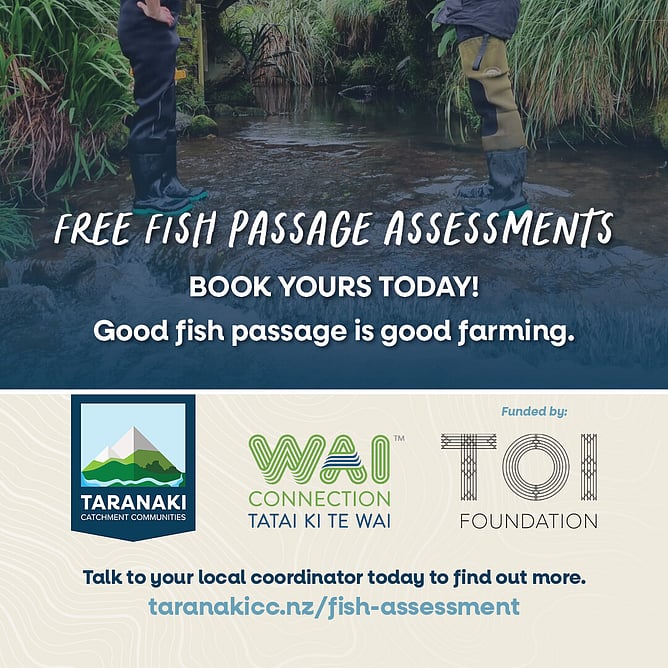
Good fish passage is good farming. TCC is working alongside Wai Connection, with funding support from Toi Foundation, to help farmers better understand what’s happening in their farm streams and how small changes can make a real difference.
We're offering FREE fish assessments as part of catchment management planning. Our fish passage team has been trained by freshwater expert Dr Cindy Baker from Earth Sciences New Zealand, so assessments are done properly and with your farm context in mind.
Healthy waterways support species like īnanga, a key indicator of freshwater health, and contribute to more resilient catchments overall.
If you’re curious about what’s in your stream or want to know whether fish are getting through, have a chat with your local coordinator today to book a free assessment.
To find out more about fish passage assessments, visit taranakicc.nz/fish-assessment.
If you don’t know who your local coordinators are, visit taranakicc.nz/catchment-groups.
Taranaki’s Water, Our Future
Healthy waterways rely on people working together. Taranaki has more than 20000 km of waterways, and many people are working hard to protect them. Farmers, iwi, hapū, schools, councils and community groups all play a part, and Taranaki Catchment Communities helps bring that work together. Watch the full story at taranakicc.nz/freshwater to learn more about our work.
Our two new videos share the story of how Taranaki Catchment Communities connects farmers, iwi, hapū, local businesses and community groups to restore and protect freshwater across the region. The full version focuses on Taranaki and the work happening within our 15 catchment groups and 34 sub catchments. The short version highlights how collaborative catchment work can support freshwater restoration in other regions across New Zealand.
Reducing Farm Contaminants
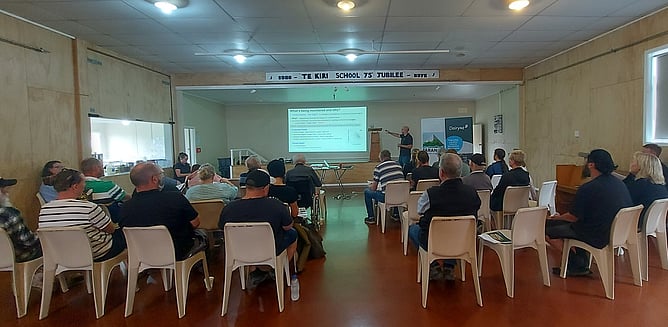
A big thank you to everyone who attended our event at Te Kiri on 2 February, hosted by the Awatuna/Auroa Catchment, HADES and DairyNZ, to learn more about reducing farm contaminants and supporting healthy waterways.
Guest speaker Dr Craig Depree shared practical insights on E. coli, nitrogen and sediment, along with the latest water monitoring results for the Awatuna/Auroa Catchments and Pihama/Oeo Catchments.
Thanks also to Taranaki Regional Council for their ongoing support and collaboration. Great to see farmers coming together to stay informed and make positive change.
CSA Factsheets
The Good Farm Planning Hub continues to support Taranaki farmers in developing customised plans that balance profitability with environmental responsibility. At its heart is the resource hub, goodfarm.nz, a one-stop platform offering free planning tools, templates and learning opportunities to help farmers navigate changing regulations and plan for the future.
Through workshops, one-on-one support, and partnerships with local experts, the programme has helped farmers tackle individual challenges and implement practical solutions. The website offers straightforward guidance on integrated farm planning tailored to Taranaki conditions.
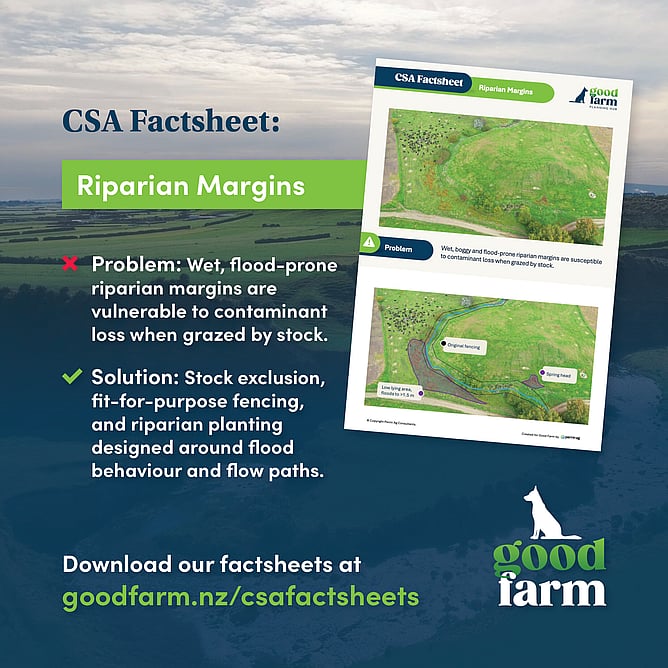
A recent addition is the Critical Source Areas Factsheets at goodfarm.nz/factsheets. These 14 downloadable guides explain where sediment, nutrients and contaminants are most likely to leave a farm during wet weather, and outline simple actions to reduce losses while supporting animal health, safety and farm efficiency.
The page also includes short videos showing how to identify these areas and take practical steps to manage risk, meet requirements and protect water quality. Check them out!
New FREE Mapping Experience Tool
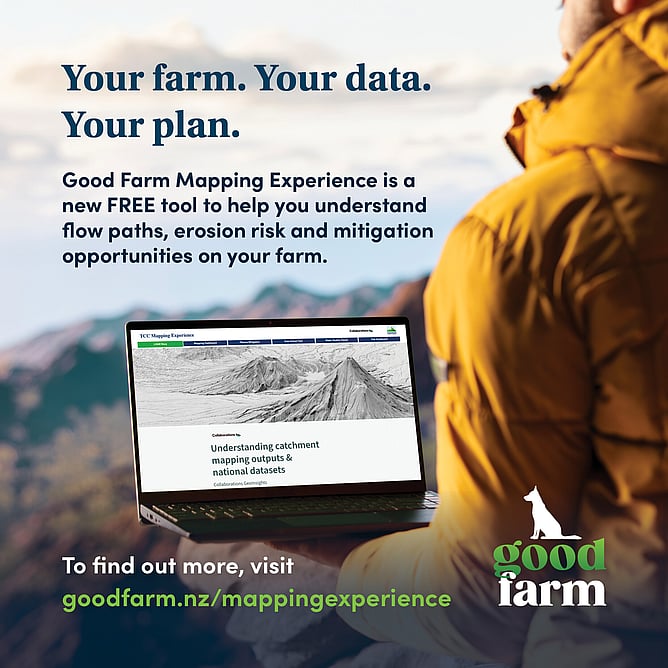
Good Farm has just rolled out a new, free tool for farmers that turns complex environmental data into practical, farm-scale insights. Plus, you get to download your personal Farm Plan for free.
The Good Farm Mapping Experience tool uses high-resolution LiDAR data and proven environmental science to show how water, nutrients and sediment move across the landscape. The result is a clear visual picture of flow paths, erosion-prone areas, wet zones and opportunities for effective mitigation, tailored to individual farms and catchments.
This work has been developed in partnership with Collaborations, an environmental and water science consultancy specialising in spatial analysis and catchment-scale modelling. Collaborations has taken nationally available LiDAR data, already paid for through public investment, and applied peer-reviewed science to transform it into practical outputs that land managers can actually use.
LiDAR technology creates a highly accurate 3D model of the land surface. From this, it is possible to map things like ephemeral flow paths, contributing catchments, erosion risk, areas of water accumulation and existing vegetation. When combined with national datasets and scientific guidance, this information becomes a powerful planning tool rather than just a technical map.
For farmers, the value is simple. The Good Farm Mapping Experience helps identify where issues are most likely to start, not just where they end up and mitigation options. It supports better targeting of mitigations, more informed conversations with advisers, and stronger farm and catchment planning. Maps and data can be exported and shared with tools such as Overseer or visual farm systems.
More importantly, this tool is free to access. It’s hosted on a secure online platform and available to farmers through your local catchment group. The focus is on supporting practical decision-making, not adding another layer of compliance.
If you’re interested in accessing the Good Farm Mapping Experience, visit goodfarm.nz/mappingexperience to get your unique login and password.
Good Farm in Practice
Good Farm has just released three new farmer case studies showing how the Good Farm modules support practical, no-nonsense farm planning. These stories come from Taranaki farmers who used the modules in ways that suit their own businesses, making them ideal examples for catchment groups to share with their communities.
The case studies highlight the following focus areas:
Biodiversity and animal welfare
Awatuna dairy farmers Donna and Philip Cram found more biodiversity on their farm than expected and used the modules to understand their progress, identify new opportunities and strengthen their knowledge of welfare requirements.
People and biosecurity
Kaponga dairy farmer Murray Perks used the modules to bring scattered plans together, identify gaps and formalise systems that support staff and protect business continuity.
Emergency planning and greenhouse gases
Eltham farmer Hayden Lawrence used the tools to refine emergency planning, understand risk scenarios and identify small but meaningful changes that support long-term resilience.
These videos demonstrate what Good Farm is designed for: practical, farmer-friendly templates that support integrated planning without adding unnecessary complexity. They are straightforward tools for helping farmers organise their thinking, understand risks and make informed decisions.

Catchment action planning
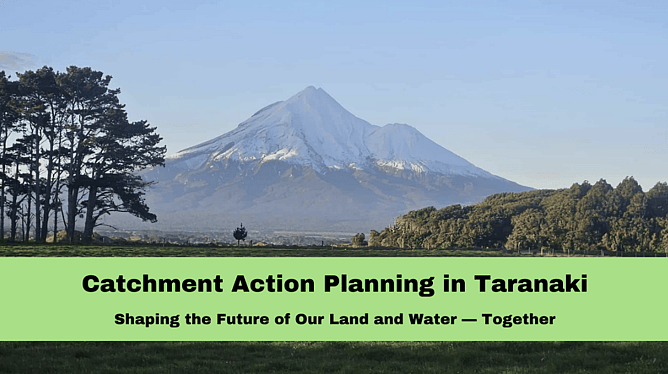
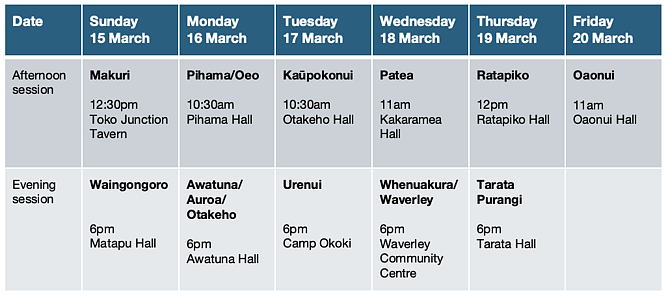
You’re invited to help shape the future of your catchment. Join us for a relaxed session to share your ideas, local knowledge, and priorities for the place you live and work. RSVP at www.taranakicc.nz/events today.
What’s this about? TCC is developing Catchment Action Plans shaped by the people who live and work in each catchment. These plans set a shared direction, highlighting what matters locally, what’s already happening, and where working together can make the biggest difference.
Why get involved?
Your local knowledge helps ensure the plans:
focus effort where it will have the greatest impact
deliver practical, locally relevant actions
improve coordination between community, agencies and funders
strengthen the case for future funding through measurable progress
What is Integrated Catchment Management (ICM)? ICM takes a whole-of-catchment approach. It connects land, water, biodiversity, climate resilience, and community needs to focus on actions that deliver the greatest long-term benefit.
Why it matters
Keeps local voices at the heart of decision-making
Aligns communities, farmers, hapū, iwi, councils and funders around shared priorities
Focuses on outcomes, not isolated projects
Helps track progress across the whole catchment
Come along, have your say, and be part of shaping your catchment’s future.
Please RSVP at www.taranakicc.nz/events for catering purposes.
Lunch/dinner will be provided.
Solar solutions
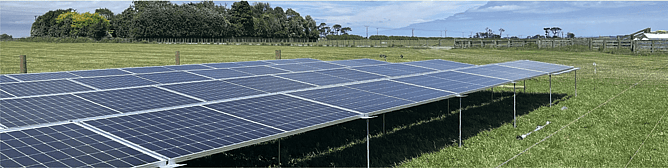
Thinking about solar for your farm? Join DairyNZ on-farm this March to explore how solar technology can reduce energy costs, improve efficiency and support a more resilient farming system.
This Solar Solutions session will be held at Jeff and Sharon Nicholas’ farm in Kaponga, where attendees will hear directly from farmers who have already adopted solar, along with expert insights from Matt Luscombe (FarmGen), Jamie Silk (Rural Energy Group) and many others on batteries, payback considerations, financing options, and what the future of solar energy looks like for the industry.
Date: 11 March 2026
Time: 10:30am – 1pm
Venue: 468 Palmer Road, Kaponga, SN 41675
Visit the DairyNZ events page to find out more, and register here.
Why attend?
This session is designed for owners, sharemilkers and anyone considering whether solar is right for their farming system.
You’ll walk away with a clearer understanding of the costs, practical considerations and long-term potential of solar energy, helping you decide if now, or later, is the right time for your business.
Lunch is provided by FarmGen, and beverages by ASB.
Get the FACCTs: Science-Based Workshops for Smarter Farming
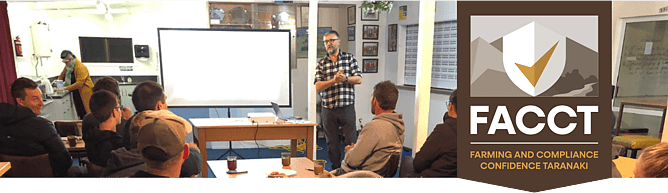
Our FACCT (Farming and Compliance Confidence Taranaki) workshops, part of the Good Farm project, are continuing to help Taranaki farmers build a deeper understanding of farm science to support productivity, profitability and compliance.
The hugely successful 10-session series, led by local farmer Campbell McCowan from PLANit Farming, covers topics like catchment geology, soils, erosion, nutrients, freshwater, and greenhouse gases. Farmers are finding real value in the practical, unbiased info and collaborative atmosphere, with many saying it's helping them future-proof their farms.
Keep an eye on www.taranakicc.nz/events for future sessions.
Why TCC Matters
TCC is farmer-led and focused on practical support. We work alongside farmers and communities to help them set priorities, build local connections and take action that fits their catchment.
By linking groups, sharing tools and supporting collaboration, TCC strengthens local voices and backs outcomes that matter on the ground. This short video offers a quick look at what that work looks like in action and the difference it’s making.