Spring is always a busy time across Taranaki, and it’s been great to see so much happening across our catchment communities over the past few months.
In this edition, we’re sharing some of the work happening on the ground, from community events and practical workshops to projects supporting our waterways, biodiversity and rural communities. We’re also excited to share TCC’s refreshed vision, purpose, objectives and values, which reflect where we’re heading and our ongoing commitment to locally led, practical action.
There are plenty of opportunities to get involved too, whether it’s joining a matuku-hūrepo night muster, taking part in the FACCT programme, coming along to our weed and biosecurity day in November, or joining us at our AGM in October. We hope you enjoy catching up on what’s been happening and find something that sparks your interest.
A big thank you to our catchment groups, coordinators, partners, funders and volunteers for the time, energy and support you continue to put into making a difference across Taranaki.
Ngā mihi, Paul Turner – TCC General Manager
Project and News Updates
TCC AGM
You're all invited to our upcoming 2026 Annual General Meeting.
Join us on Wednesday 28 October at 7pm at Stratford War Memorial Hall. Light supper and refreshments will be provided.
Come along to hear what we’ve been up to over the past year and find out what we have planned for the year ahead. Let’s celebrate our awesome achievements and set the tone for the coming months.
Please RSVP by 25 October to nicola@taranakicc.nz. We’d love to see you there.
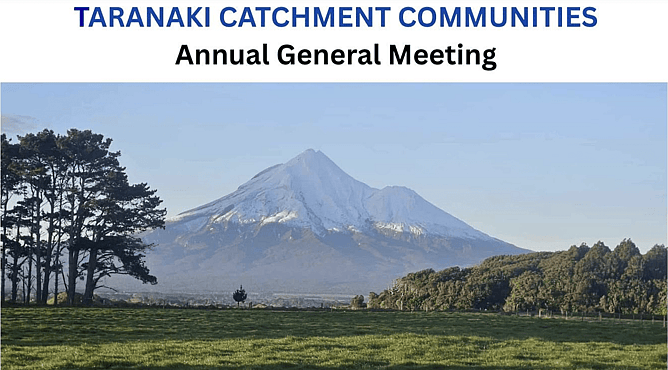
Wednesday 28 October | Stratford War Memorial Hall
Our Vision for the Future
As TCC continues to grow, so does our opportunity to support the people and places that make our region unique.
Over the past year, we've taken the time to reflect on who we are, what we stand for, and where we're heading. The result is a refreshed vision, purpose, objectives and values that provide a clear direction for our work in the years ahead.
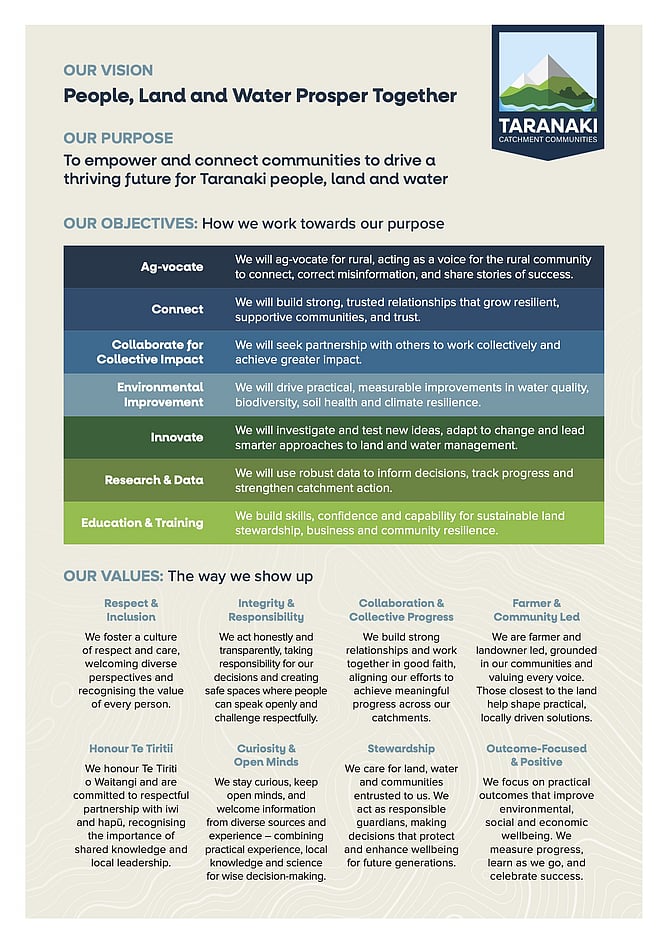
At the heart of it is a simple vision:
People, Land and Water Prosper Together.
It recognises that healthy catchments and thriving communities go hand in hand. Looking after our environment isn't separate from supporting productive farms, resilient businesses and connected rural communities, they're all part of the same picture.
Our purpose is to empower and connect communities to drive a thriving future for Taranaki people, land and water. This builds on the work we're already doing alongside catchment groups, farmers, iwi, schools, industry and communities across the region.
The refreshed objectives also reinforce how we'll achieve that purpose. Whether it's advocating for rural communities (“ag-vocating”), strengthening relationships, supporting practical environmental improvements, using good data, or building knowledge and capability, our focus remains on helping communities lead positive change.
Just as importantly, our values reflect how we work. They reinforce our commitment to collaboration, integrity, stewardship, respect for diverse perspectives, and working alongside iwi and hapū, while ensuring solutions remain grounded in local knowledge and community leadership.
While some of the words are new, our commitment remains the same: supporting communities to make practical, locally driven decisions that benefit both the environment and the people who call Taranaki home.
You'll find our new vision, purpose, objectives and values alongside this article, and we'll continue bringing them to life through the projects, partnerships and initiatives we support across the region.
New faces in our catchments
Sophia Nisbet has taken over as coordinator for the Tarata Catchment Group. Sophia farms on Tarata Road, so she knows the catchment and the people in it well.
Sophia takes over from Marcia Millard. A big thank you to Marcia for her great work with the Tarata group. Marcia isn’t going far. She is still involved with the group and is supporting Sophia with the catchment work as she settles into the role.
Thanks also to Sarah Lucas, who is stepping back from the Waiongana Catchment Group.
FACCT is back
FACCT is a free 15-session series delivered by local farmer Campbell McCowan from PLANit Farming. The new programme is split into three modules: Land, Air and Water, with four learning sessions per module and an optional hands-on workshop.
Sessions are approximately two hours and are held every two weeks, with flexibility around busy farm and family schedules. They are designed to help farmers better understand the science behind their farms, build confidence and make informed farming decisions. There are 60 places available across the three cohorts!
The first group started at Matapu Hall on 15 October. Two more groups start in early February 2027, one in rural Inglewood and one in coastal Taranaki, so if Waingongoro doesn’t suit, there are more options in the new year.
Previous participant Kathy says the workshops gave her greater confidence in understanding the changes affecting farming.
“Campbell’s talks provide an amazing opportunity for our small farming community. I feel so empowered being able to educate myself further, and know Campbell’s up-to-date and science-based information is trustworthy and relevant. He puts together engaging short seminars for us to attend locally. His down-to-earth nature, enthusiasm and natural rapport make all his presentations engaging right to the end.”
There's no application process. If you'd like to take part, email hello@taranakicc.nz with your name, location and phone number.
For more information on the new series of workshops, visit www.taranakicc.nz/facct.
Weed and biosecurity day
Save the date! TCC is working alongside DairyNZ and MPI On-Farm Support to host a weed and biosecurity day for farmers on Tuesday 17 November.
Our speaker is Trevor James from AgResearch Ruakura. Trevor has worked on yellow bristle grass for nearly 20 years and possesses in-depth knowledge of the invasive weeds farmers deal with. If there’s a weed on your property you can’t identify or manage, bring your questions along.
Keep an eye on our Facebook page for more details, including the location, time, and how to RSVP.
Matuku-hūrepo breeding season
The breeding season for matuku-hūrepo (Australasian bittern) is underway, and TCC is working with landowners and volunteers to learn more about this critically threatened species in Taranaki.
Last month, bittern expert Wendy Ambury visited Taranaki and connected with TCC, sharing her expertise and sparking kōrero across our catchments about how we can better protect matuku-hūrepo and improve their breeding habitat.
Wendy provided advice to landowners on wetland habitat improvements, including opportunities to expand predator trapping to target the predators that have the greatest impact on breeding success.
In the Makuri catchment, planning for the matuku-hūrepo pilot we introduced in the winter newsletter is continuing with local farmers. Toko School is building a wetland on the school grounds to attract bittern, and land management specialist Matt Highway visited in September to look at options for an eroding drain. The project is still in the design stage, and physical work hasn’t started yet.
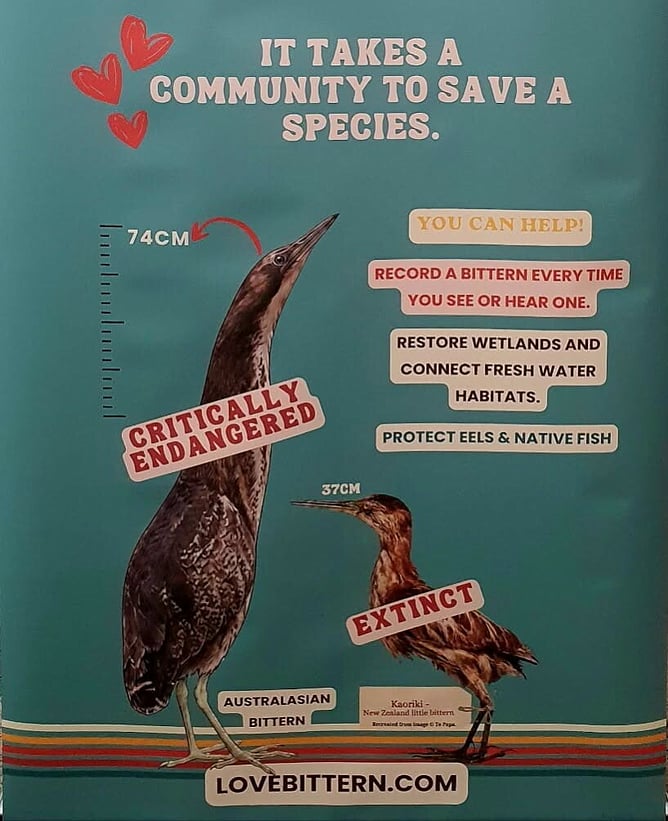
We’ve planned a number of volunteer night musters at wetland sites during the breeding season. They involve listening for the distinctive deep booming call of male matuku-hūrepo and recording the birds heard. With fewer than 30 known matuku-hūrepo recorded in Taranaki, these surveys are an important opportunity to add to our knowledge of where they are and help build a clearer picture of the species’ status in the region.
If you’d like to join us for a night muster, please email nicky@taranakicc.nz for more information.
A big thank you to the Love Bittern Project for their ongoing expert advice and support.
Water Care Project gets underway
The Awatuna/Auroa/Otakeho Catchment Group kicked off its Water Care Project back in June, thanks to funding and support from Westpac NZ and NZ Landcare Trust.
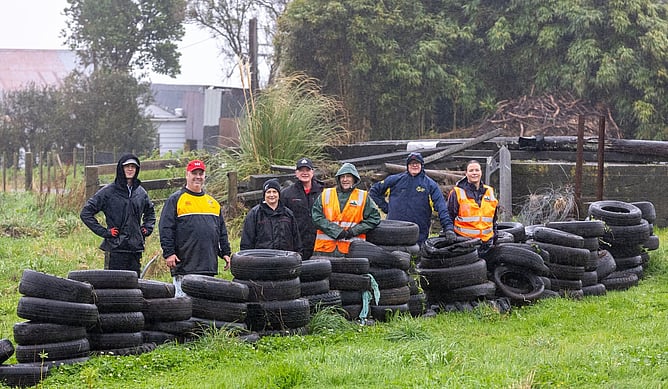
As part of the project, the Westpac team joined the Catchment Group for a working bee along the Awatuna Stream. Despite the wet weather, the team removed a large number of tyres from the stream bank and made a start on planting along the waterway.
The project is an opportunity to improve the health of the Awatuna Stream while bringing local farmers, community members and supporters together to care for their catchment.
A big thank you to everyone who got involved and to Westpac NZ and NZ Landcare Trust for helping make the project possible.
Tackling pests together
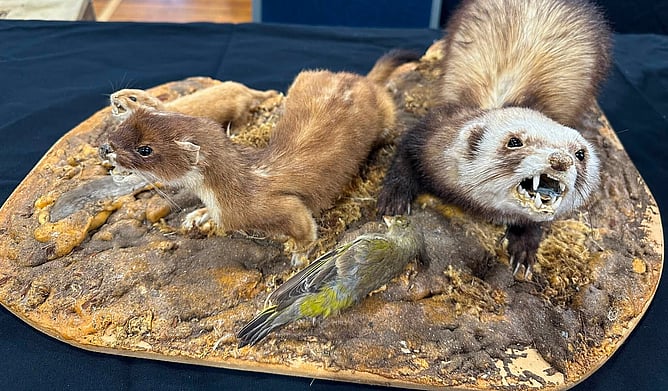
In July, the Tarata and Ratapiko Catchment Groups hosted two community workshops focused on pest plants and pest animals.
The workshops gave adults and children the chance to learn about pests identified under the Taranaki Regional Council Pest Management Plan, why they matter and what communities can do to help control them.
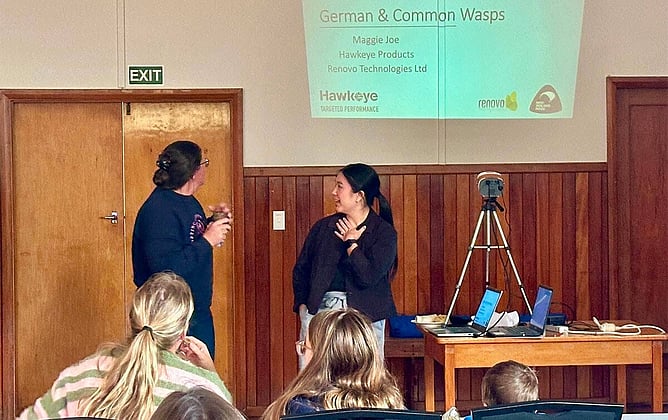
Taranaki Regional Council shared its knowledge about pest management, while Hawkeye Kiwi demonstrated its innovative wasp bait and lure system, giving participants a practical look at some of the tools available to tackle pest species.
A big thank you to everyone who took part, and to Taranaki Regional Council and Hawkeye Kiwi for helping make the workshops a success. It was great to see local communities coming together to learn, share knowledge and take practical steps to protect their environment.
Rural First Aid training
The Awatuna/Auroa/Otakeho Catchment Group hosted two Rural First Aid courses back in July, designed specifically for farmers and rural communities.
Delivered by Rural Aid, the courses focused on the types of emergencies people are more likely to encounter on farm, making the training practical, relevant and easy to apply.
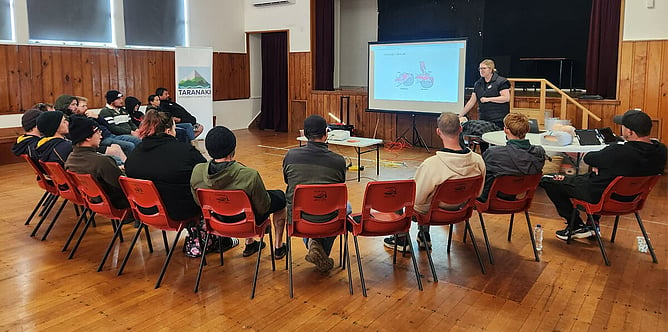
Participants described the courses as engaging, informative and highly worthwhile, with many appreciating the focus on real-life situations they may face in their day-to-day work.
A big thank you to everyone who took part and helped make the courses a success. It’s fantastic that our rural communities invest time in building practical skills and confidence that could make all the difference when it matters most.
Practical advice for lifestyle block living
The Tarata and Ratapiko Catchment Groups hosted a lifestyle block information day at Kaimata Hall on 8 August, bringing together local experts, businesses and rural organisations to share practical advice with current and prospective lifestyle block owners.
The marketplace-style event covered everything from animal health, land and waterway care and biodiversity to rural property, insurance, emergency preparedness and financial advice. Attendees could also pick up a free Lifestyle Block Handbook, connect with local services and meet others living the rural lifestyle.
The event was a great opportunity for people to ask questions, build their knowledge and discover the support available to help them make the most of life on a lifestyle block.
Emergency preparedness workshops: round two
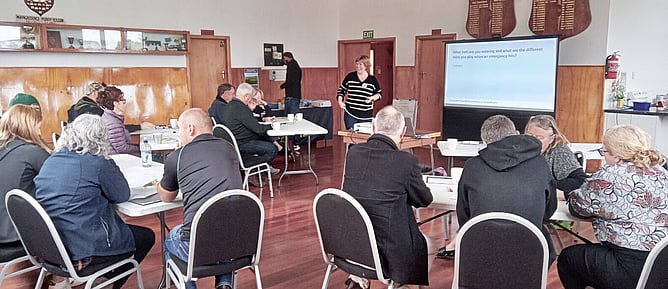
In the winter newsletter we reported on the nine emergency preparedness workshops TCC ran around the country with NZ Landcare Trust and Lee Cowan from Avalon Communications. The events were a great success, with 223 people attending.
We’re applying to NEMA to run six more workshops for groups that missed out, and we’re working on bringing the programme back to Taranaki. We’ll let you know how we get on.
Good Farm resources to support your farm planning
Looking for practical ways to support your farm planning? The Good Farm Planning Hub brings together free tools, templates and learning resources tailored to Taranaki farming conditions.
Some resources are new, while others are worth revisiting. Here are three to explore.
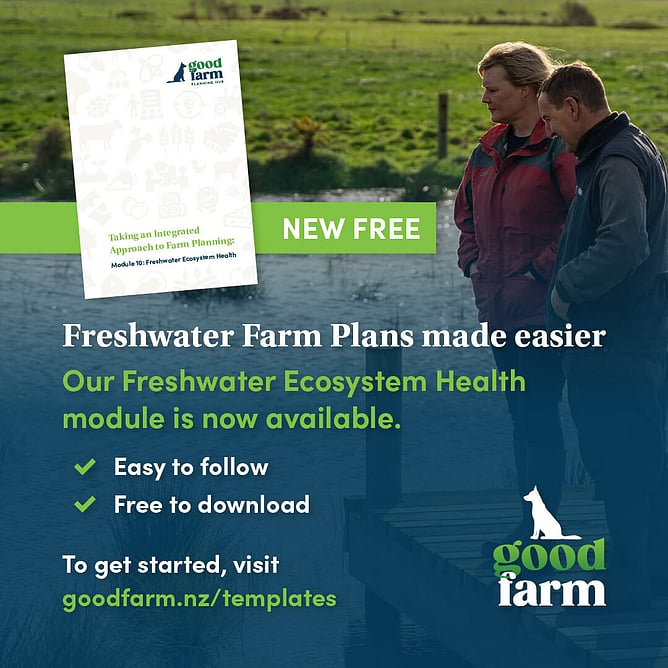
Freshwater Ecosystem Health module
Our free Freshwater Ecosystem Health module helps you understand your farm’s freshwater values, identify opportunities for improvement and build the knowledge and records needed to work towards a certified Freshwater Farm Plan. If you haven’t already, check it out at goodfarm.nz/templates.
Critical Source Areas factsheets
These 14 downloadable factsheets explain where sediment, nutrients and contaminants are most likely to leave your farm during wet weather, and outline practical steps to reduce losses while supporting animal health, safety and farm efficiency. Explore the factsheets at goodfarm.nz/csafactsheets.
Good Farm Mapping Experience
This free online tool uses national LiDAR data to provide farm-scale insights into how water, nutrients and sediment move across your land. It can help you identify erosion risks, map flow paths and pinpoint where mitigations may be most effective. You can export maps for farm planning or share them with advisers. To get started, request a unique login and password at goodfarm.nz/mappingexperience.

Thinking about solar?
Our Save Energy On-Farm project started with 20 free on-farm energy assessments. What we learned from those has gone into a Solar PV Guide for farmers, with a decision tree to help you work out whether solar makes sense for your farm.